Marisol Wickham Digital Portfolio
View the Project on GitHub 26wickhm/Wickham-Marisol-portfolio
Self-Catheterization Aid
← Back to Pearl Project
← Back to Main Page
Overview
A self catheterization aid is intended for those who need to self-catheterize at home. A person who requires this does it around 4-6 times a day. Many people, primarily women, struggle with insertion because of a lack of visuals and lighting. This is also difficult because many patients who need to self catheterize also do not have full mobility over their legs, struggling to hold them open. Therefore, my design aims to provide a leg brace for the patient (holding the legs apart), contain an adjustable mirror that they can move to increase visibility, and LED’s lining the mirror for better lighting.
Inspiration
I saw the need for this on the list that Ms. Heather Smith provided us, and after a zoom with a catheterization specialist and researching for a week, I realized the extent to which this was a necessity. It wasn’t going to simply improve life for these people, but it could literally change the way thatt they get to live their life and the increased independence that they have. After looking online, there was no design that I truly resonated with, so my idea is completely from scratch. The only other input was from the self-catheterization specialist, suggesting that I add another arch because of the difficulty there is to keep the legs open. This is something that I never would have thought of, which is why it is so important to remember that the ultimate feedback you can get is from patients and people who work at the hospital. They will tell you not what is flashy, but what is needed.
Cost
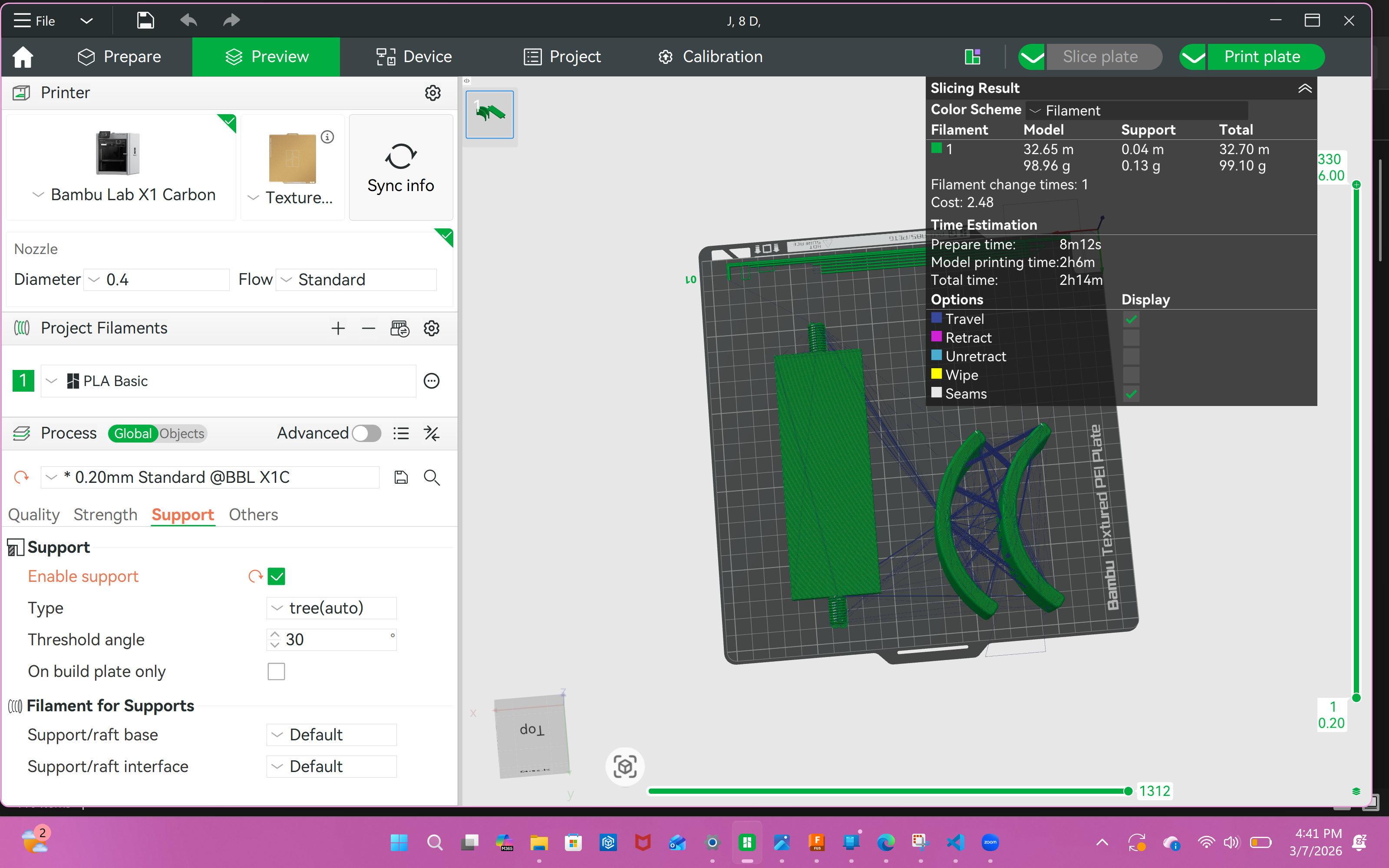
Estimated cost breakdown for the self-catheterization aid components
- This screenshot accounts for the cost of PLA in the first prototype (it will likely increase because the plank will need to be wider and thicker).
- The expense from the mirror and LEDs will be added once the PLA base size and comfortability are finalized.
- Current prototype price: $2.48, not including additional components.
-
This section will be updated as each new component is included.
Project Management
My plan for this project was less structured, because I was much less familiar with the topic, and knew that each time I researched I would be led in a different direction. However, my plan was roughly research, zoom with doctors, prototype, and adjustements until complete. As of right now, I am in the prototyping stage of this, but my timing is going accordingly to plan. This will continue past the school year and into the summer. I hope to have a usable prototype by the end of the school year, and continue improving it over the summer with the input of experienced self-catheterizers.
Tools
- Fusion360
- Bambu Studios
Files
Direct Download (Threaded Bar STL)
Mistakes and Challenges
The largest mistake that I made was trying to make the difficulty very high before I even had a base to work off of. I began working on a hirth joint and different mechanisms to tighten before I realized that the solution was much more simple. I overcame this challenge by deciding to negate the complexities that I was worried about and instead began to just work off of my imagination and sketches. This resulted in a simple threading mechanism connecting the arches to the plank. It ended up having the desired effect of a stable mirror with the remained ability to rotate. This challenge results in me learning that I need to break my work into smaller steps instead of increasing the difficulty and making it more complex for myself. I have taken this mindset and continued to use it as I continue my project.
Summary
This project taught me alot. One of the things is that similar to my work with the donning tube, I have understood more about the innerworkings of a hospital and patient need. Self Catheterization is not a subject that people want to discuss, which is why I capitalized on it. This internship is intended for the people who need help, and I am happy that I got to research. I also learned how to be professional, including going into Zooms with an intended meeting plan and coordinating emails with different specialists that I was put in contact with. This summary is not complete, as this project is still in the beginnings of work. I will update this at the end of each prototype.
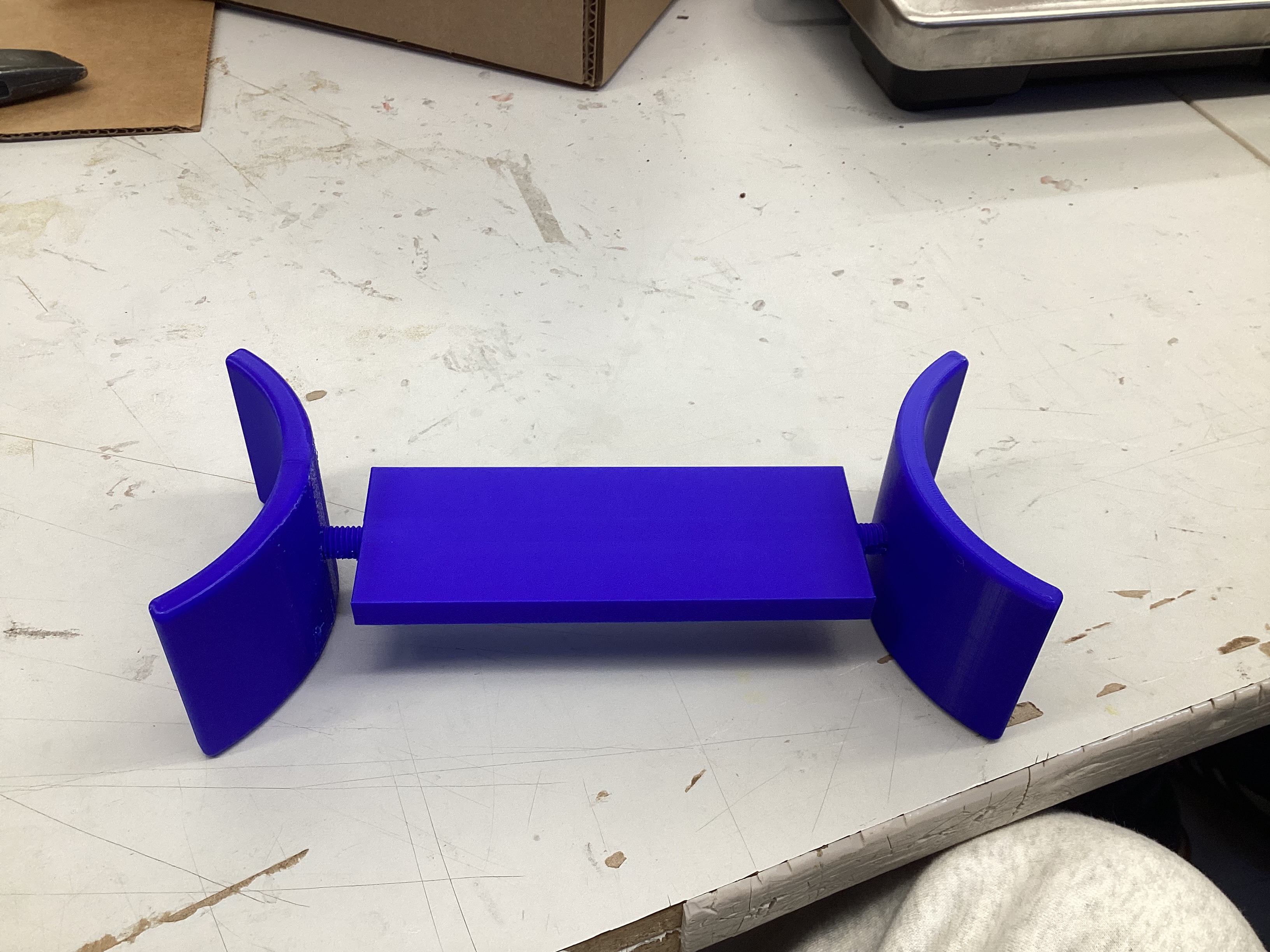
Prototype Photos
 |
.jpeg) |
Research
Largest causes of a need for self-catheterization
Neurogenic bladder
- effects both men and women
- Caused by:
- Spinal cord injury
- Multiple sclerosis
- Spina bifida
- Stroke
- Parkinson’s disease
- Diabetic autonomic neuropathy
- Cauda equina syndrome
- Transverse myelitis
- Bladder emptying is impaired because nerve signals don’t work properly
- Normally long term
Obstructory urinary retention
In men
- Benign prostatic hyperplasia
- Prostate cancer
- Post prostate surgery complications
- Urethral strictures
In women
- Pelvic organ prolapse
- Urethral strictures (rare)
- Post pelvic surgery obstruction
Post-surgical urinary retention
- The bladder doesn’t empty properly after surgery due to anesthesia or nerve irritation
- Pelvic surgery (gynecologic, colorectal)
- Orthopedic surgery (hip, spine)
- Urologic procedures
Dysfunctional voiding / detrusor underactivity
- Bladder muscle is weak or uncoordinated.
- Aging population
- Idiopathic chronic retention
- Long-standing bladder overdistension
- Some psychiatric medication effects
Documentation
This is all of the documentation specifically about the self catheterization aid. If wanting to see full documentation page about all of my work in this class, please click here:
Documentation
12/1/25-12/5/25
This whole week is combined documentation because we had a review week on electrical engineering. This included a lot of Tinkercad, where we simulated different circuits including some with LEDs, potentiometers, servos, and Arduinos (obviously with the necessary parts like buttons, resistors, wires, etc). This week was helpful because our projects have a required electronics component. While mine may not, the self-catheterization aid discussion later included LEDs for visibility, so this review reinforced foundational knowledge for possible mirror lighting integration.
1/7/26 - 1/14/26
Throughout these days, I have thoroughly been researching self-catheterization aids. This has involved looking at the market and discovering the average price, who dominates the market, and why they are underserved. My research includes the largest needs for self-catheterization (neurogenic bladder, obstructive urinary retention, post-surgery urinary retention, dysfunctional voiding), the gender gap and how this leads to less interest in aids, the cost of each part, and how this is approved or accepted by the community who self-catheterizes. All of this research will be laid out cleanly in my section.
My initial design idea (basic sketch) is to use CAD to create an arc that molds to the leg (not tight so that it can be adaptable) combined with straps that thread through the printed arc and strap around the leg. This makes less of a need for PLA to reduce cost and also allows the patient to tighten or loosen the strap accordingly. Finally, this arc will connect to a medical-grade mirror between the legs. I have not decided if I want to make it completely permanent or slightly adjustable. There are benefits and consequences to both. I will meet with Heather Smith tomorrow to go over my research and discuss what she and patients would prefer.
1/15/26
Today I had a Zoom meeting with Heather Smith (occupational therapist), accompanied by an amputee specialist and a self-catheterization specialist.
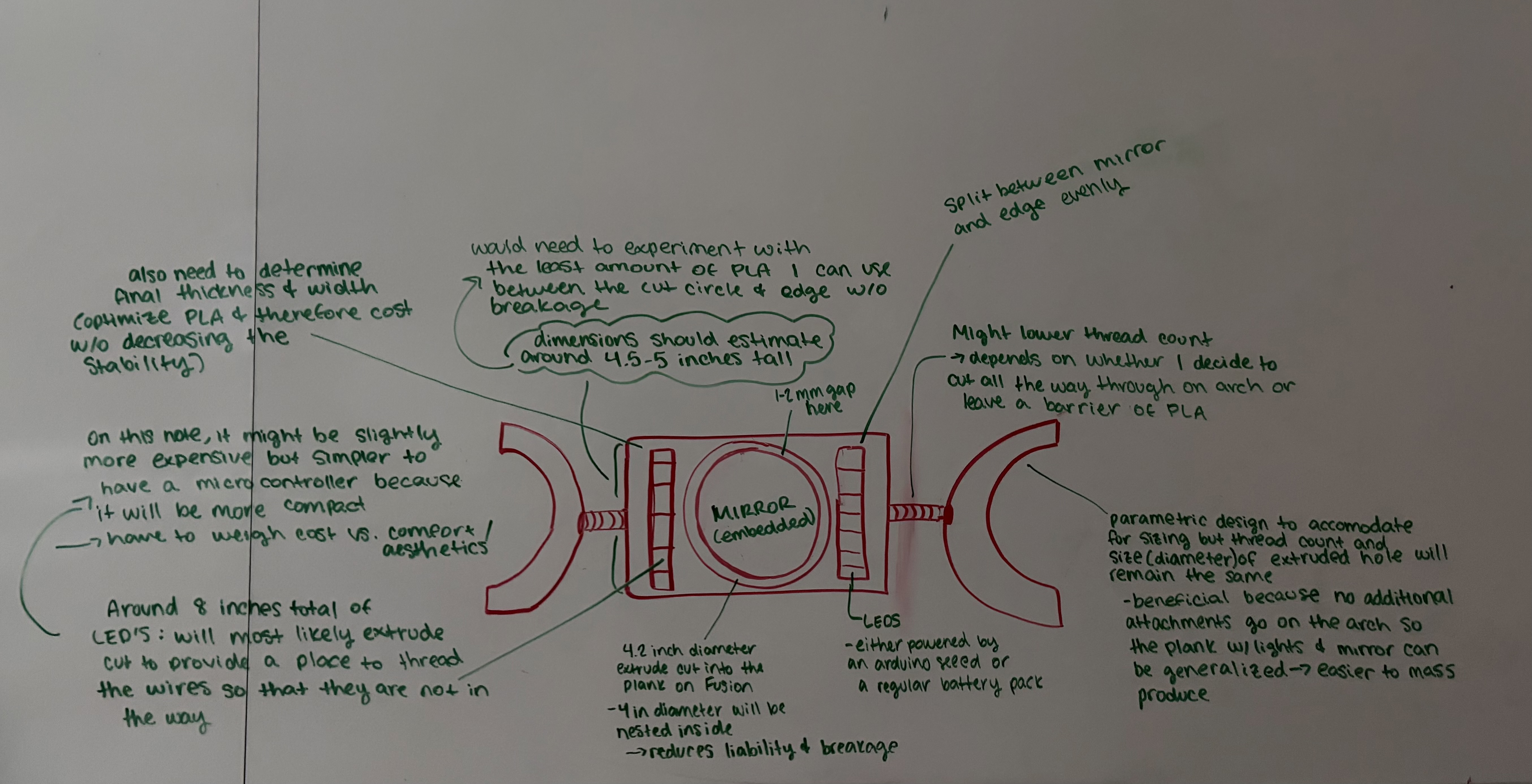
We discussed the catheterization aid. This conversation was very exciting because the self-catheterization aid is a needed device among nurses at every hospital. The things we considered were two arches to spread the legs and a plank-like board in between with a mirror attached. There should be LEDs and the mirror should have the ability to turn on the axis of the bar for better visibility.
1/16/26 - 1/23/26
This week was spent in CAD doing work on a self-catheterization aid. I did a lot of research on different joints and tightening mechanisms that I could combine. This has been very difficult because when I find a joint that I like, it seems to be hindered by the material, the durability, or the fact that my tightener needs to transfer the bolt from vertical to horizontal.
I created a Hirth joint in Fusion because I like the idea of a system that “clicks” when they rotate to adjust. This clicking system would allow adjustability of the mirror or plank while preventing unwanted shifting during use. Along with this, I made an arc in Fusion with suggested parameters, but this part will include trial and error including feedback with the specialist. I also spent a lot of this week researching the mechanisms that will work best together that I can design while proving to be the most durable over time.
2/4/26 - 2/5/26
I decided to get started on printing the self-catheterization aid because I was starting out way too complicated. I decided to forgo the hinge for this exact moment and focus on overall structure. Therefore, I added threading to the plank and extruded a cut circle through the arc and threaded both to see how well they attach and if the leg spreaders will be even.
2/6/26
I spent this class printing a small version of the Fusion work I did yesterday. This is to test my threading and so that I can test how I want to lock the system without printing the large item. I also planned to design more screws to trap the threaded plank.
2/9/26 - 2/12/26
While printing donning tubes, I have been in CAD updating the self-catheterization aid. This consists of confirming the threading and not extruding the cut all the way through the arch so that the arch rests comfortably on the thigh.
2/18/26
I figured out the threading between the arch and plank. The next step is comfortability and discovering what sizes everything should be to optimize the size of the mirror while still being portable.
2/19/26
Today I further altered the design of the self-catheterization aid by increasing the amount of material and reducing the hole and threading on the arch. This is because on the print from yesterday, I felt as though if I pushed harder with the plank, it could break through the arch.
2/20/26
Today was the first successful print where all of the threading came together. This is a very big breakthrough because while it is adjustable, it is not easily knocked. This ensures that the patient can rotate the mirror for the best visibility but it will not be knocked around while the patient is inserting.
The other benefits are that it is deconstructable and therefore more portable. The next step will be to add slits for a strap to go through around one of the thighs. I am also printing a whole new set because the supports on the bar messed up the threading a little bit and I want a clean set to demonstrate.
2/23/26
Today I began to map out the parametrics for the self-catheterization aid. This will be much more helpful when I determine the different sizes that people need because it will allow me to print multiple different sizes without spending time on the design. This means that I can be more efficient and drop off multiple sizes for the doctors to experiment instead of the back and forth and trial and error.
2/24/26
I put a pause on the parametric design for the self-catheterization aid right now because until I determine the thickness of the arch, whether I want it to slant, and whether I want the holes with threading extruded all the way through, making it parametric would simply make it more work later on.
I altered the design today to extrude the holes all the way through and printed this. My two options right now would be to 1) increase the thickness of the arch so that I can make the barrier more sturdy without subtracting the thread count or 2) completely extrude the cut through. The struggle with the second option is that if threaded through too much, the user will feel the plank because it can be threaded beyond the arch. I will most likely provide Heather Smith with both next week and confirm which one she wants me to pursue or if I should continue two prototypes for now.
2/26/26
The things not included but were emailed designs and video demonstrations are my self-catheterization aid. I decided not to include it in the drop-off because a video is much more helpful to explain the concept, the deconstructability, and how it can toggle to adjust the mirror.
2/28/26 - 3/6/26
This week has been in contact with Heather Smith. We had a meeting with her and she provided insight on each of our projects. As of right now, the video I sent her was VERY positively recieved and she seemed very pleased with the progress I had made. She also gave information on typical mirror size (around 4 inches in diameter) so that I can adapt my design accordingly. Future design will inclufe an extruded cut for the mirror as well as extruded cuts for the LEDs to lie in. Ideally, there will be a cut through in the PLA for wires to be threaded through, increasing the look of professionalism. These updates to the plank will be made next week.