Marisol Wickham Digital Portfolio
View the Project on GitHub 26wickhm/Wickham-Marisol-portfolio
Donning Tube
← Back to Pearl Project
← Back to Main Page
Project Overview
Donning Tubes are a tool to put on compression socks. This is important for amputee patients because the end of the limb needs to be molded after surgery. The compression sock (shrinker) is loaded onto the tube and then slid onto the limb. This reduced friction on the limb as well as ensuring that thre sock is taught and does not have bunches of fabric. I did not use a specific reference as inspiration for this project because the hospital was the source who brought this necessity to my attention. Instead, I consulted with Heather Smith about what the object of a donning tube was, if it needed to be in a cone shape, etc. From there, I simply built a cylinder with handles that looked somewhat like the images that I found online. However, the majority of online images look very different than mine, which is what I believe makes mine different and easier to use. This project is still underway; far below is a current update that I change every time there is news from Atrium and I send over new sizes, new prototypes, etc.
Cost
- Average weight: 345 grams
- Average cost: $9.00
- however, since this device is easily changed based on diameter and height, the price will change as well
STEPS IN IMAGES
### below shows the broad progression of the donning tube in Fusion360
| Step 1 | Step 2 | Step 3 | Final |
|---|---|---|---|
.png) |
.png) |
.png) |
.png) |
Dimensions as a Parametric File (in inches)
View on GitHub
Direct Download (STL)
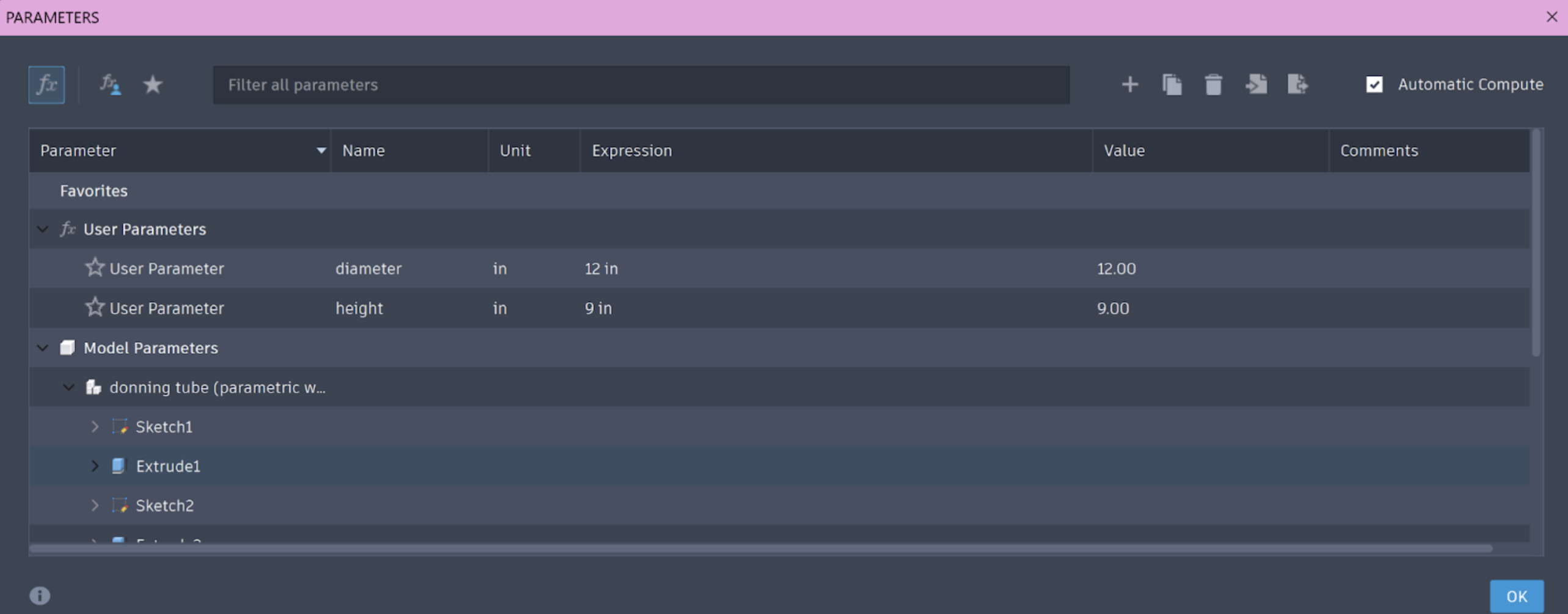
There are two variables in this design. Every single dimension is centered around the diameter of the design except for the height. I decided to do this because I wanted to be able to adjust the height is a patient needed a longer or shorter body. The default settings on this is a diameter of 12 inches and a height of 9 inches.
Modeling Steps
All dimensions are defined relative to the diameter.
1. Base Cylinder
- Diameter:
D - Width (wall thickness):
D + 0 - Height:
H
Steps
- Sketch a circle with diameter
D - Offset the circle to define wall thickness
- Extrude upward by height
H
2. Handles
- Handle width:
0.1667 × D - Handle length:
1.91667 × D - Handle height:
0.1667 × D
Steps
- Sketch handle profile
- Extrude handles upward by
0.1667 × D
3. Cutout for Handle Bar
- Offset plane:
H + 3 - Cutout diameter:
D - Cut depth:
H + 3
Steps
- Create an offset plane at
H + 3 - Sketch a circle with diameter
D - Extrude cut through the body
4. Fillets
- Bottom & sides of handles:
0.020833 × D - Top of handles:
0.075 × D
Materials
Software: Fusion360 and Bambu Studio
Machinery: Bambu 3D printer
**no handtools were used for this project
Final Design Views
| Bottom View | Home View |
|---|---|
.png) |
|
| Side View | Top View |
|---|---|
|
.png) |
There were no handtools used in this project. The only thing that one would use would be a sander, but adapting the fillets in the design would make this much better.
Summary This project was very eye opening to me because it did not involve fancy electronics and the design does not look very difficult. However, working with Atrium has allowed me to see that the most important work sometimes is the “easy” things that not everyone has access to. This is why it was so rewarding to create a design that focused on making it easier, more cost efficient, and customizable. I also learned how to do parametrics in Fusion360, which I will continue to expand upon and advance my confidence in. In the future, I hope that this design becomes more mainspread and amputtee patients that need it can simply send the diameter of their limb and the preffered height (standard, long, short) and it can be quickly modified and produced. Of course, if more people utilize the donning tube, then I would be excited to hear feedback and adjust the file accordingly to accomadate or address an issue that I earlier missed.
Current As of right now, I am working on producing sizes for Atrium hospital. This includes the production of labeled sizes such as J with a diameter of 8. While confirming sizes, the handles are removed in order to reduce PLA usage and increase the amount of tubes I can make. I will update again when I hear back and begin making the real ones with handles as well as all sizes with the appropriate STL files and updates instructions. As of right now, the hospital has possesion of sizes G and F with no handles. Size J is being printed right now. Sizes G and F have the same inner diameter of 6.5, but F has a slightly thicker model, so the overall cicumference is a bit larger. J has a diameter of 8 inches, and therefor will have a circumference of around 25 inches.
Challenges The main challenge in this design is the handles. They are not difficult to design, but there was much discussion about the usability of the design with them there. This is because they are both beneficial and get in the way. Previous to this design, Heather Smith (OT) spoke about how in order to keep the sock from slipping up the tube before application, it would hook around the ends. This creates a challenge because with the handles, there is no way for the sock to go around them and hook onto anything. My initial idea was to create a divit before the handles so that the sock had something to grip onto and hold it into place. However, after practicing with a compression sock and consulting with Ms. Smith, she made the final decision that the handles were positive to users and that if the height was not too short, then the compression sock should have no problem holding until application.
Documentation To read through my day to day documentation, go to the documentation page. This does not only involve documentation on the Pearl project, but more of a recording of each day regardless of what I am working on. Below is what I extracted from my overall documentation to give only information about this project.
10/06/25 Today we began designing the donning tubes. I made the design for the donning tube, but everyone else had input on dimensions. Our plan is to have 2 variations each with three possible sizes to ensure that the donning tubes can reach a wider group of patients. There will be short or long donning tubes that come in small, medium, and large sizes.
10/07/25 Today I completed my 5 versions of the donning tubes and uploaded screenshots to the Git. I will add my designs to the shared drive with the hospital and will print next class.
10/08/25 I printed out the medium handles donning tube and had to scale it down to 70% to be able to fit on the printer because the design is too big for the plate.
11/5/25 Today I learned how to create parametric designs in Fusion 360. I learned this for the main intention of adapting my donning tube. This is because while there can be generic sizes (small, medium, large), it is much more effective to use variables to define dimensions such as length, width, diameter, filleting, etc. I deleted the 5 versions of the files I had and created two instead. Both are parametric; one has handles and one does not.
11/11/25 The feedback I received about the donning tube is that parametric is a very smart way to keep the design, the tube can be one diameter instead of cone-like, and that there is a slight problem with the handle. While she did enjoy the concept, sometimes they put the sock over the opposite end of the tube to secure it while they roll it on. After discussion, I realized that we can keep the handles if I can create a ledge above them for the sock to hold on to.
11/12/25 – 11/13/25 On these two days I worked to make my design better with the changes that Heather Smith advised. To do this, I added a hollowed out triangle revolving around the cylinder right above the handle to create a place for the compression sock to hook around. However, there are a few challenges with this. For one, I had to abandon the parametric design for now because I was back in the designing stage. The second issue is that I cannot tell if the hook will have enough space under it for the sock without printing a whole new donning tube. They take around 7 hours to print and take a lot of PLA, so I try to refrain from doing so until necessary.
12/10/25 Today we went in person to visit Atrium Rehabilitation Center and meet with Heather Smith regarding our designs. I brought my donning tube (with generic sizing of a diameter of 12 inches and a height of 9 inches). Heather was initially concerned about the handles getting in the way of the sock, but after consideration, she decided that it did not and was actually a great design idea. This means that I reverted my Fusion file to the original design without the section to hold the sock in place.The donning tube was left with her and will be implemented on the next amputee patient who needs it.
12/10/25
Today I went back and made the final donning tube design parametric. Before, I had many variables, but I decided that I only wanted to have 2. I made every single dimension dependent on the diameter (except for the height). I wanted the height to be separate because there may be a need for a longer or shorter body regardless of the width. This included every offset, fillet, and extrusion being an equation revolving around the variable diameter.
12/11/25 I also completed my Git page for the donning tube. The only thing I may have to do is copy and paste certain documentation over to it so that someone does not need to read through all of my documentation if they only want the parts about the donning tube.